
Checking on Aging Parents
Should I Get My Parent a Daily Check-In Call — or a One-Tap Text?
By The Cozy Check-ins team·Last updated July 16, 2026
You've been looking at daily check-in calls for seniors — a friendly voice (or a robot) rings your parent every morning, and if they don't answer, you get an alert. It sounds right. But your parent screens calls, or hates being interrupted, or you're just not sure a daily phone call is how they'd want to be checked on. There's a quieter option: a daily text they answer with one tap.
Quick answer: same job, different delivery
Daily check-in call services ring your parent at a set time each day and alert family if the call goes unanswered — with a wide price range depending on the type of service. A one-tap text check-in sends the same daily check-in as a message your parent answers themselves, whenever it suits their morning. Both are non-medical reassurance, not emergency services. The right pick comes down to your parent's phone, their personality, and who they want in control of the moment.
What daily check-in calls for seniors do
Telephone reassurance is the original daily check-in — senior centers, county agencies, and sheriff's offices have run free versions for decades, and Maryland even operates a statewide one. Paid services range from automated calls at the low end to live-operator calls at the high end, with twice-daily live calls costing the most. Check each provider's current pricing directly — it changes. If the call isn't answered, most services retry, then notify family. The strengths are real: a voice feels human, live operators can chat for a moment, and calls work on any phone — including a landline with no screen at all.
Why some parents dislike daily calls
A scheduled call only works if your parent is near the phone at that exact time. Miss it in the shower or the garden and the retry-then-alert chain starts — a false alarm, and after a few of those people stop taking the alerts seriously. Automated calls can feel robotic ("press 1 to check in"), and plenty of older adults simply don't answer the phone anymore; many were told for years not to answer unknown numbers. And the deeper thing families tell us: being called and checked on daily can feel like being managed. Some parents love it. Some quietly resent it.
What a one-tap text does differently
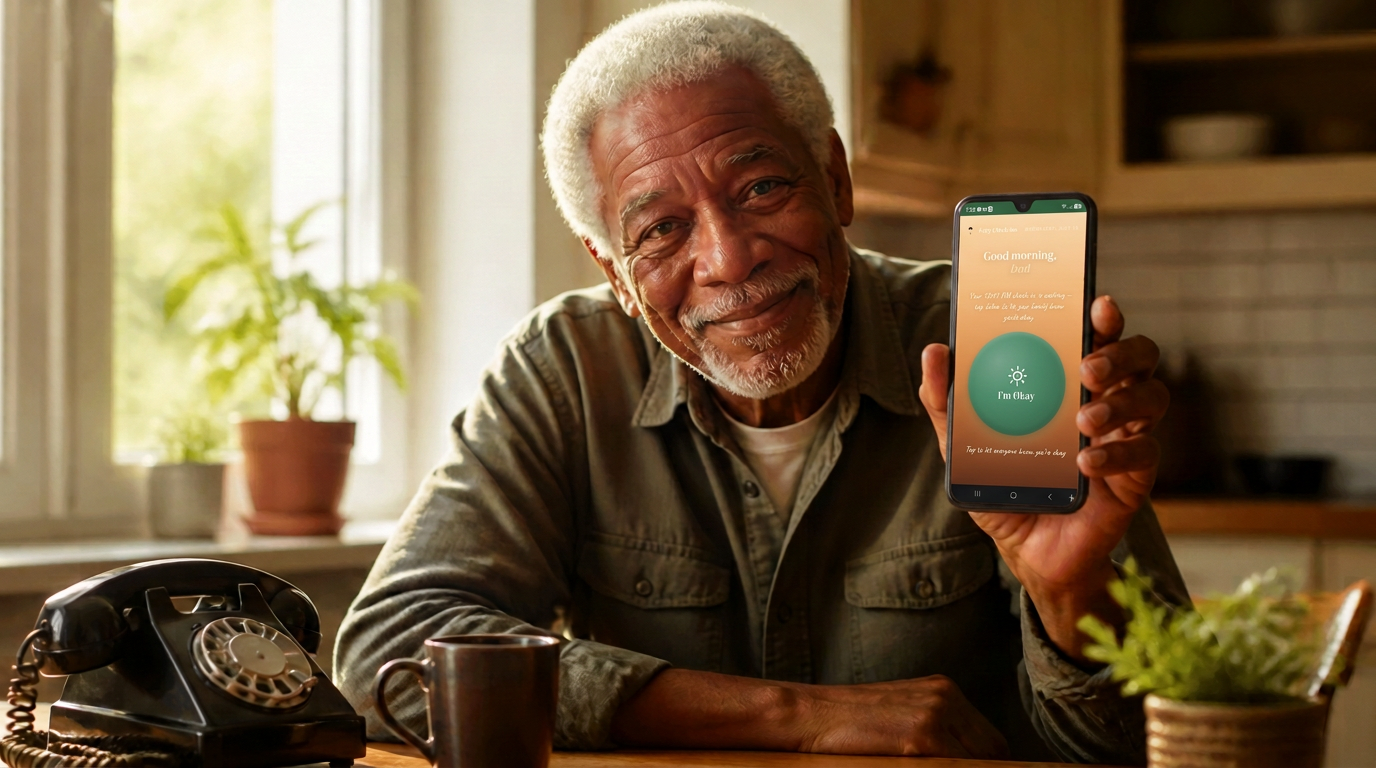
A one-tap check-in flips who's in charge. Each morning your parent gets a text with one big button — they tap check-in when they're up, on their schedule, in two seconds. No conversation required, and no set time they have to wait by the phone, nothing to install or learn. Everyone in the family Circle sees the same check-in, and if the tap doesn't come by the agreed time, family gets the alert so a real person can call or swing by. They check in without being interrupted — here's how it works. And texting isn't a barrier for most: 78% of adults 65 and older now own a smartphone (Pew Research Center, 2026), and the button works from a regular text thread.
Honest comparison: calls vs. one-tap texts
- Who acts: a call service checks on your parent; a one-tap text lets your parent report in themselves. For some families, that difference matters more than anything else.
- Timing: calls happen at the service's scheduled moment; a tap happens on your parent's own schedule within the morning window.
- Phone needed: calls win for landline-only parents — a text check-in needs a phone that receives texts. (Cozy offers both: the text by default, and a short daily call with "press 1" for a parent without a smartphone.)
- False alarms: unanswered calls (shower, garden, screening) trigger more of them; because there's a window of time to tap, a slow morning doesn't set off an alert.
- Cost: call services run roughly $15–$100 a month as of August 2026, depending on automation vs. live operators; text check-in services are the least expensive option in the category (our pricing).
- Emergencies: neither is an emergency service — that's 911 and, if it fits, a medical alert.
Which one fits your parent?
Pick a daily call if your parent has only a landline, loves a phone chat, or genuinely wants a voice — the free county telephone-reassurance program near them is worth checking first, and Cozy can place a short automated daily call too. Pick a one-tap text if your parent guards their independence, screens calls, keeps their own hours, or has ever said "you don't need to check up on me." If you're still weighing the whole landscape, our guides to choosing a senior check-in service and non-emergency alternatives to Life Alert go deeper.
If the one-tap morning sounds like your parent, that's exactly what Cozy Check-ins does — one daily text, one tap, whole family reassured. And if they don't have a smartphone, Cozy can call them instead; they press 1. Join the waitlist, or see how it works.
Cozy Check-ins is a daily check-in tool that helps families stay connected. It is not a medical, monitoring, or emergency service and should not be relied on for emergencies. In an emergency, call 911.
Frequently asked questions
- What is a telephone reassurance program?
- A service — often free, run by senior centers, county agencies, or sheriff's offices — that calls an older adult daily to check in and alerts a contact if the call goes unanswered. Paid versions cost more as they add live operators and more calls per day. Check current pricing with each provider.
- What if my parent only has a landline?
- Then a daily call is the better fit — calls work on any phone, while a text check-in needs a phone that can receive texts. Cozy can place that call: a short automated call each day, and your parent presses 1 to check in. It's also worth checking whether your county or state runs a free telephone reassurance program.
- Are automated daily calls or texts better for seniors?
- It depends on the person. Automated calls suit parents who won't use any screen; one-tap texts suit parents who dislike interruptions or screening calls — they answer on their own schedule with a single tap, and 78% of adults 65+ now own a smartphone (Pew Research Center, 2026).
- Do call services or text check-ins handle emergencies?
- Neither. Both are non-medical reassurance services: they tell family that a daily check-in was missed so a person can follow up. For emergencies, families rely on 911 and, where it fits, a medical alert device.
The Cozy Check-ins team
Cozy Check-ins is a daily check-in for older adults — one tap in a daily text, or a short daily phone call for a parent without a smartphone. No app needed for them (an optional app is coming — always optional).
More from the blog

Checking on Aging Parents
My Parent Doesn't Have a Smartphone. Can a Daily Check-In Still Work?
About one in five adults 65+ still doesn't own a smartphone. A daily check-in can still work for them: one short automated call, press 1. Here's exactly what the call says, what happens if they don't answer, and the free programs worth checking.
September 19, 2026

Checking on Aging Parents
My Parent Can't Drive Anymore. How Do They Get to Medical Appointments?
The car keys are gone, and the appointments aren't. Here's where rides to medical appointments actually come from — Medicaid, Medicare, PACE, paratransit, volunteers and phone-booked rides — and who pays.
September 16, 2026
Checking on Aging Parents
Phones for Seniors: How to Choose One Your Parent Will Actually Use
There isn't one best phone for every older adult — but there is a best way to choose. Start with what your parent actually does with a phone, then pick the simplest thing that does exactly that.
September 16, 2026