Organizations & Communities
Supporting Older Adults Who Live Alone: A Community Model That Doesn't Replace Family
By The Cozy Check-ins team·Last updated October 17, 2026
Nearly 3 in 10 adults age 65 or older lived alone in the United States in 2022, according to the U.S. Census Bureau (May 2024); by 2023 that figure was about 26% (Pew Research, December 2025). Living alone is not the same as being unsafe or unhappy — many older adults live alone by choice and thrive. But it does mean that on any given day, if something changes, someone needs to be paying enough attention to notice.
Living alone is common — and so is the worry that comes with it. If your parent lives by themselves, you're far from alone in worrying. About 26% of U.S. adults ages 65 and older lived alone as of 2023. Living solo doesn't mean someone is unsafe — but it can mean fewer people would notice quickly if something were off. The CDC, citing the National Academies of Sciences, Engineering, and Medicine, notes that "nearly one-fourth of adults aged 65 and older are considered to be socially isolated". A simple daily check-in is one low-pressure way for families to stay in the loop without hovering.
>
Cozy is a non-medical peace-of-mind service, not a medical alert or emergency system.
Quick answer: a few people sharing the job works better than one person doing all of it
The most resilient support for an older adult who lives alone isn't a single family hero and isn't a single institution — it's a small circle of ordinary, agreed-upon relationships (family, a trusted neighbor, a community group, existing professional services when needed) with one small shared daily signal so no one is alone in noticing. The older adult stays at the center. Every other role exists to support the life they've chosen, not to redirect it.
Why living alone deserves a calm response
The CDC notes that many older adults go most of the day without speaking to anyone. That doesn't mean living alone causes any of these outcomes on its own — most people who live alone are perfectly connected — but it does mean the quality of connection around an older adult is worth thinking about. The problem to solve usually isn't "this person shouldn't live alone." It's "how do we make sure a quiet day gets noticed without anyone panicking?"
The circle, one person at a time
The healthiest support model spreads the weight across a few people who each carry a small, defined piece.
The older adult is the center. They choose what kind of contact they want, from whom, and how often, and can end any arrangement at any time. Nobody is doing them a favor; they direct their own life, and the circle helps.
Family knows the person best and makes the personal decisions. When family lives at a distance — 11% of family caregivers live an hour or more away from the person they help (AARP & National Alliance for Caregiving, Caregiving in the U.S. 2020) — a shared daily check-in keeps everyone informed.
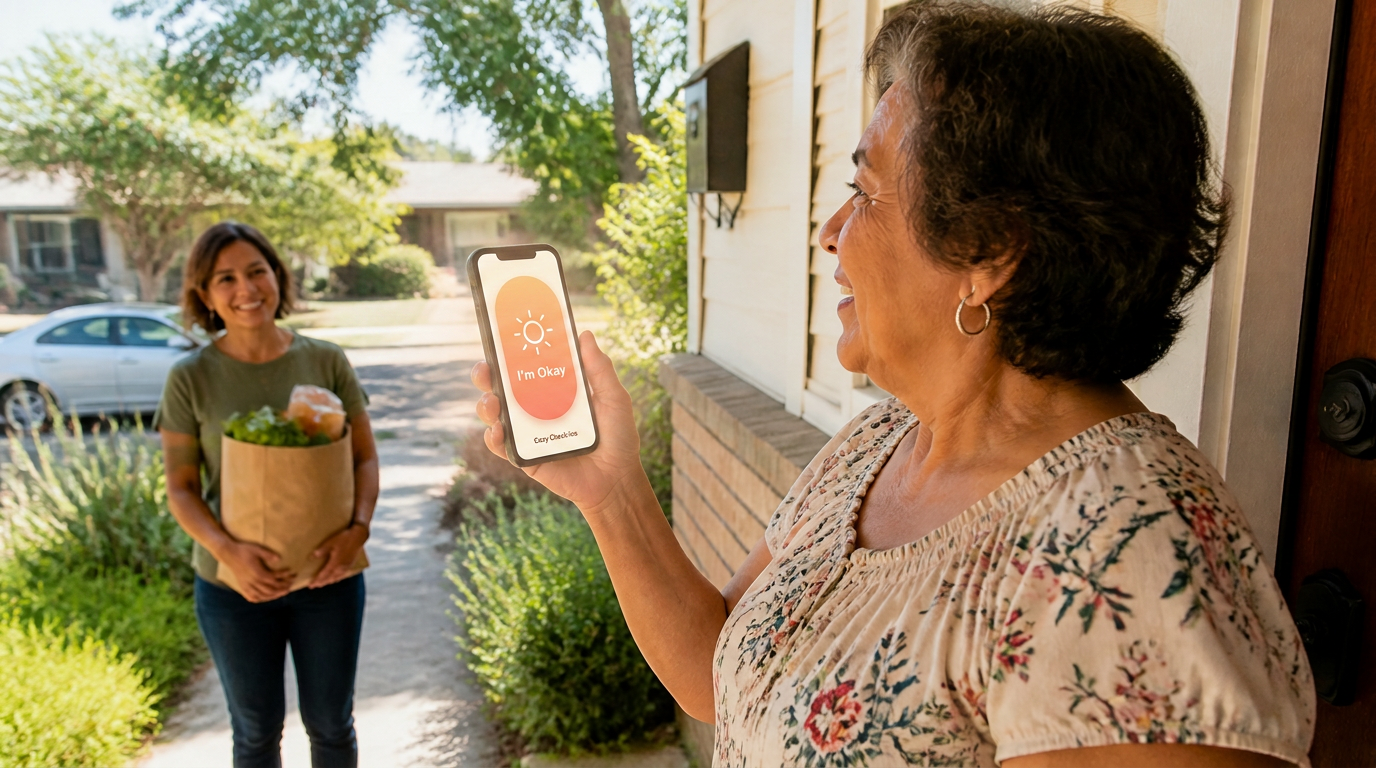
A trusted neighbor is an in-person contact chosen by the older adult: a friendly knock on a slow day, not entry or care. A neighbor can do what a device can't: knock on the door or wave from across the street.
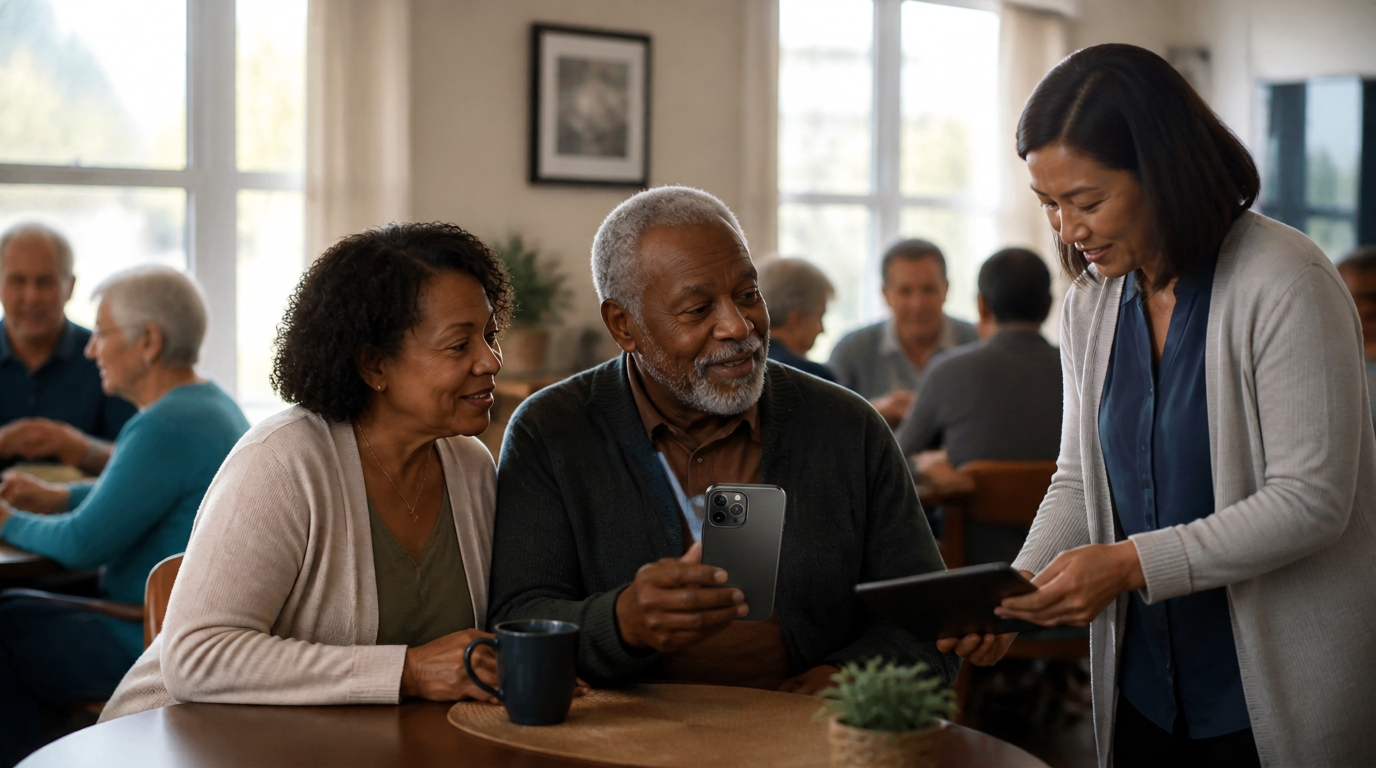
Community organizations bring continuity — the senior center, the VFW post, the congregation, the nonprofit that has known this person for years. A community organization is not a family and shouldn't try to be one, but it can maintain the routine, hold local knowledge, and make the calm outreach call when a check-in doesn't come through. For a practical playbook, see how to start a daily check-in program for older adults.
Existing professional and public services — home care, case managers, telephone reassurance, meal delivery, medical alert systems, primary care, Area Agencies on Aging, and the Eldercare Locator — all keep doing their jobs. A community circle doesn't replace them; it points to them when it should.
911 is for any suspected emergency. Not a text, not a check-in tool, not a group chat.
One daily check-in, not constant monitoring
The point of a daily check-in here is small and specific: the older adult sends one signal each day; the small circle can see it came through; when it doesn't, a real person follows up.
One tap a day: the older adult lets their circle know they checked in.
Some things it deliberately is not: not a health monitor, not a location tracker, not a camera in the living room, and not proof of anything when a check-in is missed — it's a prompt for a person to look up from what they're doing. Keeping it limited is deliberate. Older adults are more, not less, willing to participate in a light routine when it doesn't feel like surveillance.
What the circle looks like on an ordinary week
Nothing dramatic — that's the goal. Most mornings, the daily tap goes through; family sees it, nobody has to talk about it. A neighbor waves on the way to the mailbox. On Sunday, the family calls — a real call, not a status check. Every few weeks, a check-in comes late and someone follows up: the tap doesn't come at the usual time, a friendly reminder goes out, the older adult replies (she was on a walk), and everyone goes back to what they were doing. Once in a great while the ripple is bigger — the follow-up call is made, family is looped in, sometimes a neighbor knocks; sometimes it's a dead phone battery, and sometimes it isn't and the circle acts, which may include calling 911. The same routine handles both an ordinary day and a serious one.
Where Cozy Check-ins fits — and what a community group's part is
Cozy Check-ins provides one small piece of this picture: the daily signal, shared with the family's own Circle. The older adult receives one daily text at a time they chose and can respond by tapping a link. A family plan can notify the family Circle after a missed check-in, so no single adult child is the only one who knows. Cozy Check-ins doesn't use GPS, cameras, or location tracking, and doesn't sell user data.
The family Circle: everyone who hears when Mom and Dad tap their button.
When a community organization shares Cozy Check-ins with families, its part stays small on purpose. It gets anonymous monthly numbers it can use for grants and funding — how many older adults it reached and how many check-ins happened — but never names or individual check-ins, and it gets no alerts. The organization isn't part of a family's Circle and isn't a responder. The family keeps the personal decisions and its own Circle; the organization keeps its relationships and continuity; Cozy Check-ins sends the daily check-in and lets the family's Circle know when one is missed.
Serving Spanish-speaking families
For Spanish-speaking families the honest picture matters. Hispanic older adults actually live alone less than the overall 65+ population — 19% versus 26% (Pew Research, December 2025) — often within strong multigenerational families. The harder gap is language: among Spanish speakers in the U.S., only about 61% report speaking English "very well" (U.S. Census Bureau, 2018–2022), which can make public services hard to reach. A circle that works in Spanish — a bilingual neighbor, a Spanish-speaking congregation, a check-in the older adult can read in their own language — is what makes the model real for those families. Cozy Check-ins' daily check-in and family app work in English and Spanish.
Where this model quietly fails, and how to keep it honest
A few honest failure modes: the single point of failure (one family member becoming the only person who knows anything — fix: widen the Circle); silent drift (the routine goes stale, the check-in time no longer fits — fix: a short re-check every few months); over-collection (recording more than the program needs — fix: collect only what helps the follow-up); skipping consent (adding someone the older adult didn't approve — fix: ask, same as day one); and treating a missed check-in as an emergency (some are just Tuesdays — but if there's a real belief of danger, the answer is 911).
What this does not do
- It does not replace family, in-person visits, professional caregivers, home care, case managers, social workers, telephone reassurance, meal programs, medical alert systems, police, fire, EMS, 911, or Area Agencies on Aging.
- It does not diagnose loneliness, treat isolation, or produce any specific medical outcome.
- It does not track location, listen through a microphone, or watch through a camera.
- It does not replace the older adult's own judgment about who belongs in their life.
Cozy Check-ins is a non-medical peace-of-mind service, not a medical alert or emergency system. In an emergency, call 911.
Sources
- U.S. Census Bureau — Living Arrangements Varied Across Age Groups (May 2024)
- Pew Research — A smaller share of older U.S. adults live alone today than in 1990 (Dec 2025)
- AARP & National Alliance for Caregiving — Caregiving in the U.S. 2025
- U.S. Census Bureau — Language Use in the United States (2018–2022)
- Administration for Community Living — Profile of Hispanic Americans 65+ (2021)
- CDC — Health Effects of Social Isolation and Loneliness
- Administration for Community Living — Area Agencies on Aging
- Eldercare Locator
Frequently asked questions
- Is living alone dangerous for older adults?
- Not on its own. Many older adults live alone by choice and do well. The relevant question is usually not whether someone lives alone, but whether a small circle of ordinary connections is present so that a genuinely unusual day gets noticed.
- Does a community check-in program replace family?
- No. Community organizations, neighbors, and professional services support family involvement, they don't replace it. Personal decisions and long-standing relationships belong to the family.
- What if the older adult doesn't want to participate?
- That's a real answer, and the right one to respect. A check-in routine only works with consent — the older adult can decline, pause, or leave at any time.
- Does Cozy Check-ins use cameras or GPS?
- No. Cozy Check-ins doesn't use GPS, cameras, or location tracking, and doesn't sell user data.
- Is a missed check-in an emergency?
- Not on its own. It's information that starts a human follow-up. If anyone reasonably believes the older adult may be hurt or in immediate danger, the answer is 911.
- How is this different from a medical alert system?
- A medical alert system is designed for the older adult to press a button in an emergency. A daily check-in is designed to notice a normal day that stopped looking normal. Some families use both; neither replaces family or professional care.
- How can Spanish-speaking families find local aging services?
- The Eldercare Locator, a public service of the Administration for Community Living, is a free national tool that connects older adults, families, and caregivers with local Area Agencies on Aging and other community services.
The Cozy Check-ins team
Cozy Check-ins is a daily check-in for older adults — one tap in a daily text, or a short daily phone call for a parent without a smartphone. No app needed for them (an optional app is coming — always optional).
More from the blog
Organizations & Communities
Senior Check-In Programs for Organizations: How Families and Community Groups Can Work Together
A shared daily check-in doesn't replace family, caregivers, or 911 — but it can give a senior center, a family, and a trusted neighbor one small signal they all agree on.
July 19, 2026