Organizations & Communities
Senior Check-In Programs for Organizations: How Families and Community Groups Can Work Together
By The Cozy Check-ins team·Last updated October 17, 2026
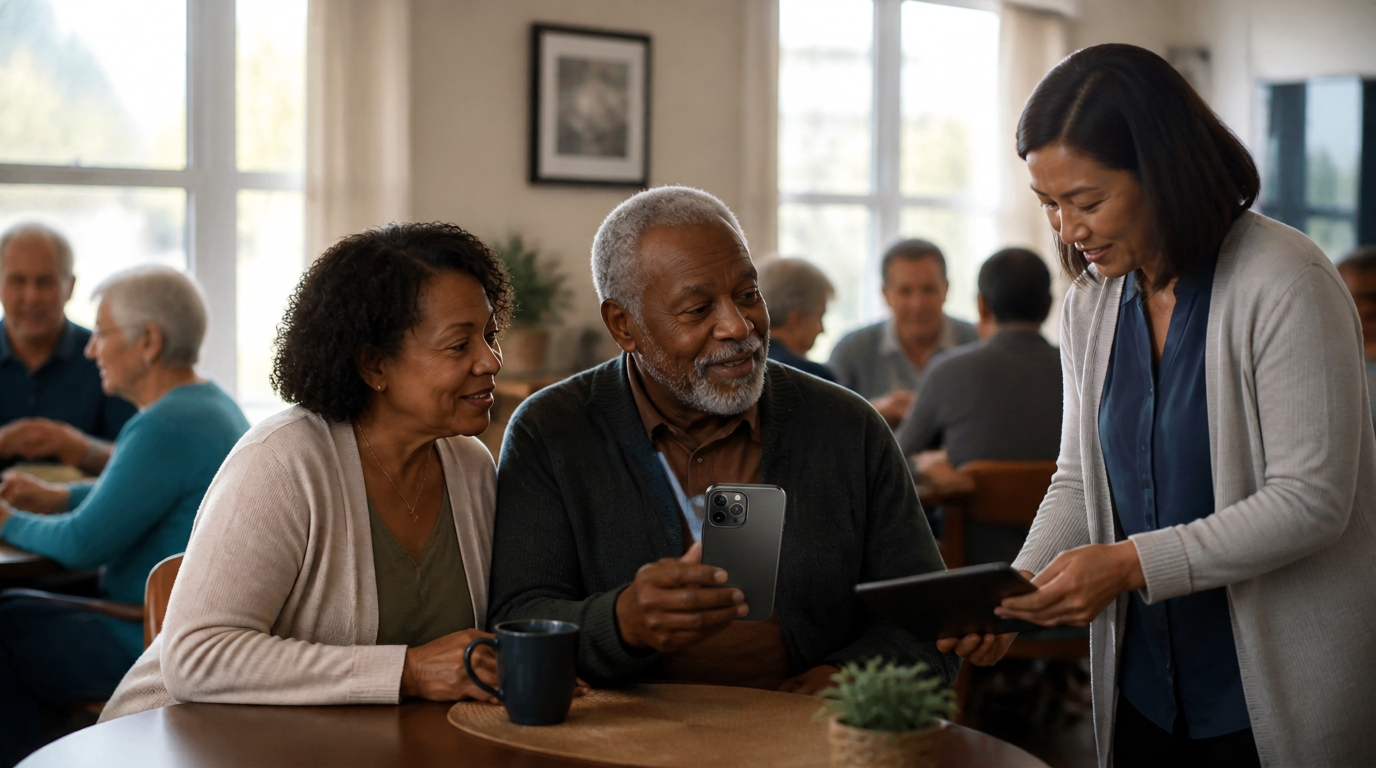
A senior center knows many members by name. Their families care deeply, but some live an hour or more away. A neighbor may be right next door. A case manager or an Area Agency on Aging may already be involved. The problem is rarely that nobody cares — it's that each person sees only a piece of the picture, and nobody is quite sure who would notice first if a normal day stopped looking normal.
Quick answer: one shared signal, many people
A senior check-in program gives an older adult a simple way to check in each day, and gives the right family members or organization staff a way to notice when that ordinary signal is missing. It works when the roles are agreed on in advance — who reaches out first, who calls the family, when to lean on existing local services, and when a suspected emergency means 911 — and when the check-in is treated as a prompt for a real person to follow up, not as a medical diagnosis or an emergency alert.
The need is real, and older adults want to stay put.
>
The CDC reports that "nearly one-fourth of adults aged 65 and older are considered to be socially isolated" (CDC, Social Connectedness: Risk Factors). At the same time, AARP's 2024 Home and Community Preferences Survey found that 73% of adults 50+ want to remain in their community as they age (AARP, December 2024). A shared daily check-in is a small, respectful way for community organizations to help both facts stay true at once.
Why this matters now — the numbers
Nearly 3 in 10 adults age 65 or older lived alone in the United States in 2022, according to the U.S. Census Bureau (May 2024); by 2023 about 26% of adults 65+ lived alone, per Pew Research (December 2025). The 65-and-older population reached 61.2 million in 2024, up 3.1% from 2023, per a U.S. Census Bureau release (June 2025).
Family isn't always close by. There are 63 million family caregivers in the U.S. today — nearly 50% more than in 2015 — and 11% of family caregivers live an hour or more away from the person they help (AARP & National Alliance for Caregiving, Caregiving in the U.S. 2020). Living alone isn't the same as being unsafe, and distance doesn't mean a family cares less. But together these facts explain why so many organizations and families are asking the same practical question: is there a small, respectful way to know that a member checked in?
What a "senior check-in program" actually is
A check-in program is a shared daily routine: the older adult sends a simple daily signal (a tap on a text, a "yes," a reply), and a defined circle of people can see that the signal came through. If it doesn't, a person — not an algorithm — follows up.
The word non-medical matters. A check-in program doesn't measure vitals, detect falls, or diagnose anything. It confirms one small human fact: today, this person answered. The value is in the conversation a missing tap starts, not in the tap itself.
What each person contributes
The most durable programs are built on the idea that no single participant is responsible for everything. Roles are defined ahead of time, in plain language, with the older adult's consent.
The older adult is at the center. They decide whether to participate, what time works, who's allowed to know their status, and when to pause. They can leave at any time.
The family holds the personal context nobody else has — history, moods, what a normal day looks like — and usually makes the personal decisions (what to worry about, who to call).
The organization brings continuity and local knowledge. A senior center, a VFW post, or a community nonprofit sees the same members week after week and knows which local services exist.
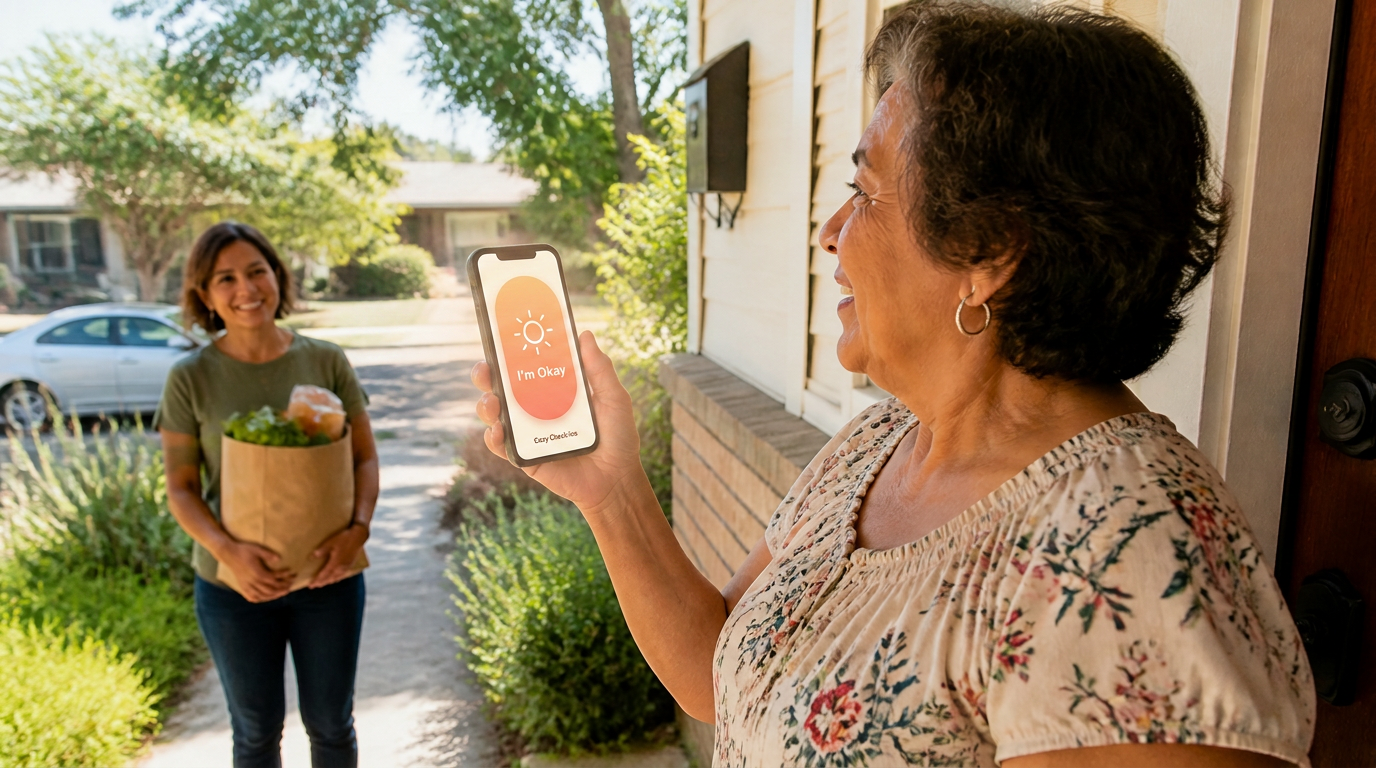
The trusted neighbor or friend is an in-person contact chosen by the older adult — a knock on the door, a wave from the driveway. Not entry, not care.
Existing community and professional services — home care, case management, meals programs, telephone reassurance, medical alert systems, and public agencies like Area Agencies on Aging — keep doing their own jobs. A daily check-in should sit beside those services, not on top of them. Many are reachable through the Eldercare Locator, a public service of the Administration for Community Living.
Where Cozy Check-ins fits — and what your organization doesn't have to do
Cozy Check-ins is a daily check-in that families set up for their own parent. The family chooses the plan and pays for it, picks the check-in time, and chooses its own Circle: family members and, on the Hometown Plus plan, trusted friends or neighbors. When a check-in is missed, the family's Circle is notified.
What your organization does: shares it. A flyer, a bulletin line, or a newsletter note is enough, and families choose whether to join. Sharing Cozy Check-ins costs your organization nothing to start.
What your organization gets: anonymous monthly numbers it can use for grants and funding: how many older adults it reached and how many check-ins happened. Your organization never sees names or individual check-ins, and it gets no alerts.
What your organization doesn't do: no accounts to manage, no check-ins to watch, and no alerts to answer. Your organization is not a responder — the family's Circle is.
That division is the whole point. Your organization keeps its relationships and its judgment; the family keeps the personal decisions; Cozy Check-ins sends the daily check-in and lets the family's Circle know when one is missed. If your organization also runs its own outreach or telephone reassurance program, the model below is how many groups do it — Cozy Check-ins sits beside that work, not inside it.
Serving Spanish-speaking members — the honest picture
If your organization serves Spanish-speaking families, the facts matter — and they're not what people often assume.
Hispanic older adults are actually less likely to live alone than the overall 65+ population — 19%, compared with 26% overall and 27% for White older adults (Pew Research, December 2025). So the story usually isn't isolation. It's a fast-growing population — the Hispanic 65+ population was about 4.6 million in 2019 and is projected to reach 19.9 million by 2060 (Administration for Community Living) — with strong multigenerational caregiving, families often split by work and distance, and a real language barrier to services.
That barrier is real: among Spanish speakers in the U.S., only about 61% report speaking English "very well" (U.S. Census Bureau, 2018–2022). For members and families more comfortable in Spanish, a program that works in Spanish — plain-language consent, Spanish materials, and a check-in they can read in their own language — isn't a nice-to-have; it's the difference between a program they'll use and one they won't. Cozy Check-ins' daily check-in and family app work in English and Spanish, which is one small piece of that.
A practical shared-response model
Every organization adapts this. The pattern below is illustrative, for a program your organization runs itself. With Cozy Check-ins, the family sets up the check-in and the family's Circle is notified; your organization isn't part of that response.
- Consent, in the older adult's own words. Before enrollment, they understand what's sent, who sees the status, what happens after a missed check-in, and how to stop. Consent is a conversation, not a signature — and for Spanish-speaking members, that conversation happens in Spanish.
- Agree on the Circle. Who may know today's status — a spouse, an adult child, a designated staff member. Keep the list in writing — a simple roster works — and let the older adult update it anytime.
- Define first contact. Who reaches out first when a check-in is missed — sometimes the organization, sometimes the family. Everyone knows in advance.
- Define when the family is contacted. Within an hour? By end of day? Written down.
- Plan for repeated non-responses. One missed day is unusual; several is a pattern worth a human conversation about hearing, transportation, phone access, or a change — not a diagnosis from a spreadsheet.
- Consult existing local services when appropriate. An Area Agency on Aging is designated by a state to address the needs of older people at the regional and local level; the Administration on Aging supports programs that help older adults live independently.
- When there is a suspected emergency, call 911. A missed check-in on its own is not an emergency. But if anyone reasonably believes a person may be hurt or in immediate danger, the answer is 911 — not another reminder text.
What a check-in program cannot promise
Being honest about the limits is what keeps the program trustworthy.
- It cannot detect falls, verify anyone's physical condition, or know why a check-in was missed.
- It cannot guarantee every message is delivered — SMS can be delayed or fail because of phone, carrier, internet, or service issues.
- It does not replace an emergency plan, in-person visits, professional caregivers, or human relationships.
- It is not a substitute for medical alert systems, home care, case management, telephone reassurance, or public safety services.
Who may want to explore this model
Groups that already see the same older adults week after week, and already know their families a little, are usually the right fit: senior centers; VFW posts and veterans' groups; community-based aging organizations and lay-led ministries; local nonprofits serving members who live alone; and congregations with active older-adult programs — including bilingual and Spanish-speaking congregations.
If your organization is exploring what a small pilot could look like, our page for organizations explains how it works, and we're happy to talk through the details. For a step-by-step start, our playbook on how to start a daily check-in program for older adults walks through the first thirty days.
What this does not do
- It does not replace family involvement, professional caregivers, home care, case managers, social workers, telephone reassurance calls, medical alert systems, police, fire, EMS, 911, Area Agencies on Aging, or in-person contact.
- It does not diagnose loneliness, treat isolation, or produce any specific health outcome.
- It does not track location, listen through a microphone, or watch through a camera.
- It does not automatically enroll anyone — families choose whether to join, and no one is added without their consent.
Cozy Check-ins is a non-medical peace-of-mind service, not a medical alert or emergency system. In an emergency, call 911.
Sources
- U.S. Census Bureau — Living Arrangements Varied Across Age Groups (May 2024)
- Pew Research — A smaller share of older U.S. adults live alone today than in 1990 (Dec 2025)
- U.S. Census Bureau — Older Adults Outnumber Children… (June 2025)
- AARP & National Alliance for Caregiving — Caregiving in the U.S. 2025 / Long-Distance Caregiving
- Administration for Community Living — Profile of Hispanic Americans 65+ (2021)
- U.S. Census Bureau — Language Use in the United States (2018–2022)
- CDC — Health Effects of Social Isolation and Loneliness
- Administration for Community Living — Area Agencies on Aging
- Administration on Aging
- Eldercare Locator
Frequently asked questions
- Does a check-in program replace family calls?
- No. A daily check-in confirms a signal; family calls carry conversation, context, and care. Most families find a light shared signal actually protects the phone calls — they can be about how Mom is really doing, not a daily quiz.
- What happens when an older adult misses a check-in?
- It's information, not an emergency. With Cozy Check-ins, the family's Circle is notified so someone can reach out; a partner organization is not alerted. If there's a reasonable belief someone may be hurt or in immediate danger, the answer is 911.
- Is Cozy Check-ins an emergency service?
- No. It's a non-medical peace-of-mind service, not a medical alert, monitoring, or emergency-response service. It doesn't contact police, fire, EMS, or 911. Messages can be delayed or fail. In an emergency, call 911.
- Does it track location?
- No. Cozy Check-ins doesn't use GPS, cameras, or location tracking, and doesn't sell user data.
- Can an organization see medical information?
- No. A partner organization gets only anonymous monthly numbers — never names, never individual check-ins, and no medical information.
- Is Cozy Check-ins available in Spanish?
- Yes. The daily check-in and the family app work in English and Spanish. For members who are more comfortable in Spanish, running the program and the consent conversation in Spanish is what makes it usable.
- How can an organization learn about local aging services?
- The Eldercare Locator, a public service of the Administration for Community Living, connects older adults and families with local services and can point staff to their regional Area Agency on Aging.
The Cozy Check-ins team
Cozy Check-ins is a daily check-in for older adults — one tap in a daily text, or a short daily phone call for a parent without a smartphone. No app needed for them (an optional app is coming — always optional).
More from the blog
Organizations & Communities
Supporting Older Adults Who Live Alone: A Community Model That Doesn't Replace Family
The most resilient support looks less like one heroic caregiver and more like a small, honest circle of ordinary relationships — with one small shared signal so nobody is alone in noticing.
July 19, 2026