Checking on Aging Parents
Senior Check-In Services in New York: Daily Sheriff Calls Upstate, Closed Doors in the City
By The Cozy Check-ins team·Last updated September 16, 2026
If your parent lives alone in New York, the help that exists depends a lot on where — an apartment in the city or a town upstate.
Quick answer
For senior check-in services in New York, start with NY Connects at 1-800-342-9871. It's the state's front door for long-term services and supports, and it connects you with the local office for your parent's county. In New York City, call Aging Connect at 212-244-6469. Some counties outside the city, including Columbia, Putnam and Chautauqua, run free daily check-in calls through the sheriff's office. And a daily one-tap check-in gives the whole family a signal, every day, that your parent checked in.
Two very different places to grow old
According to the Census Bureau's latest estimates, 19.3% of New Yorkers are 65 or older, out of about 20 million people (U.S. Census Bureau QuickFacts). That works out to roughly 3.9 million older New Yorkers.
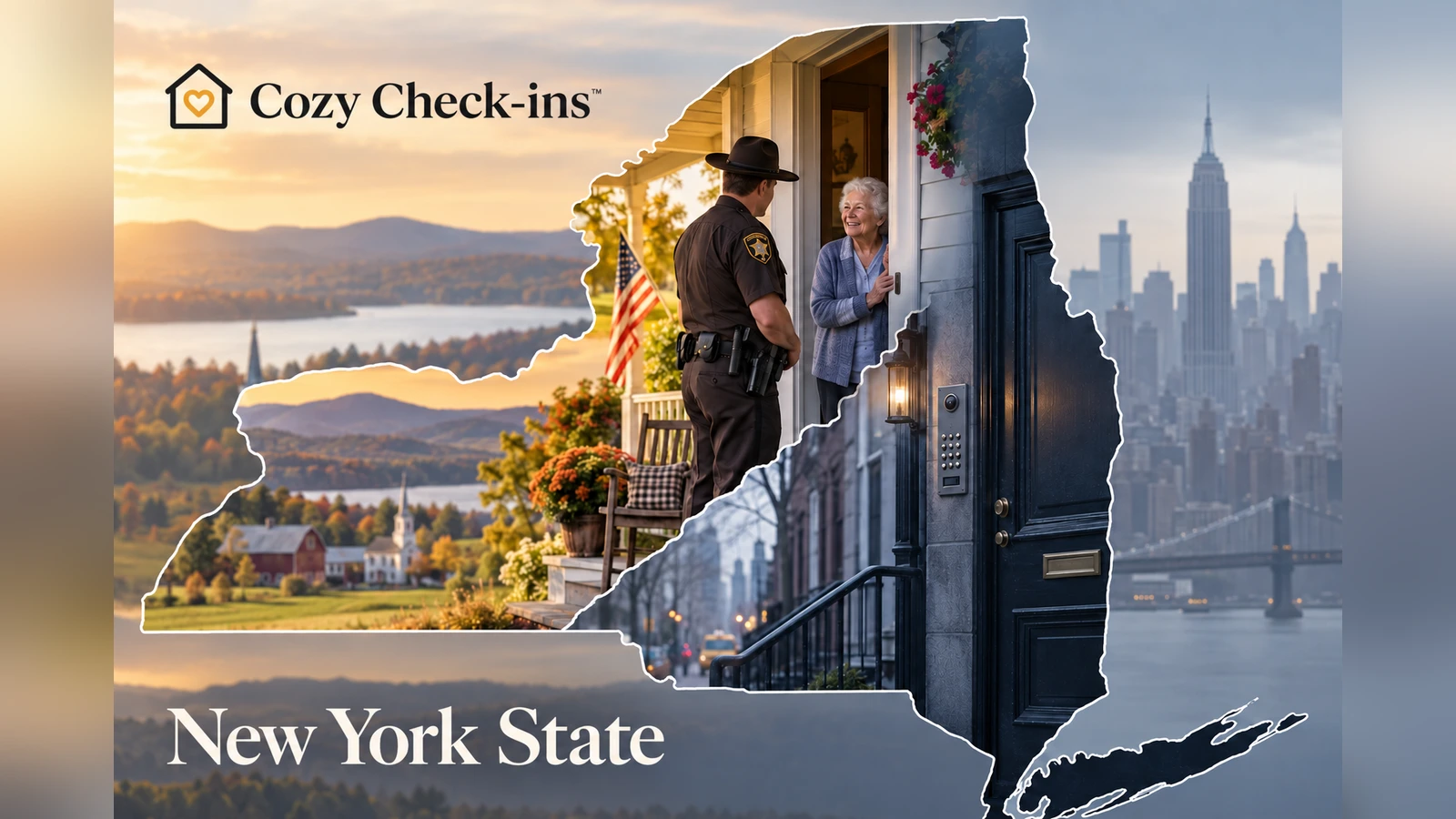
They grow older in two very different kinds of places. In the city, a parent can live alone behind an apartment door, with neighbors a few feet away who never knock. Upstate, the nearest relative can be hours away — and in a few counties, the sheriff's office already calls older residents who live alone every day.
In the city, the risk is a closed door
Living alone is common among older adults in the five boroughs. The State Comptroller found that "in 2023, 30 percent of the City's 65 and older population lived by themselves, almost three times higher than the share (11 percent) of those younger than 65" (Office of the New York State Comptroller). A city housing report puts the oldest New Yorkers higher still: "40 percent of those age 85 or older" live alone (NYC Department of Housing Preservation and Development).
Summer is when that matters most. The NYC Health Department's 2026 heat mortality report says "each summer, on average, approximately 500 New Yorkers die prematurely because of hot weather in New York City." Rates of death caused directly by heat were highest among people 60 and older. The people who died "were most often exposed to dangerous heat in homes" — and among those exposed at home where air conditioning was recorded, "none had or were using AC" (NYC Health Department).
The city's answer is people checking on people. When it's hot, the Health Department asks New Yorkers to "check on your neighbors, especially older adults, and people with mobility issues" (NYC Health Department, June 2026). Its Be a Buddy program "funds and trains community-based organizations and older adult centers to activate volunteer networks to check on residents at higher risk during heat events" in participating communities (NYC Emergency Management, 2026 heat plan).
What New York offers
NY Connects: 1-800-342-9871. This is New York's statewide front door for long-term services and supports. The New York State Office for the Aging (NYSOFA) describes it as a "No Wrong Door" system offering free, objective information and assistance, and says the statewide number "connects callers with local offices by county" (NYSOFA). NYSOFA itself works with a network of 59 Area Agencies on Aging and more than 1,200 community partners (NYSOFA). If you make one call about a parent anywhere in the state, make it this one.
In New York City: Aging Connect, 212-244-6469. NYC Aging calls Aging Connect its "information and referral contact center for older adults and their families" — the number spells 212-AGING-NYC (NYC Aging). Ask about Friendly Visiting, where volunteers keep homebound older adults company "in their home, on the phone, or on video" (NYC Aging).
2-1-1, and 3-1-1 in the city. Across the state, 211 connects people to local help around the clock — call 211 or text your ZIP code to 898-211 (211 New York). In New York City, the three-digit number for information and referral is 311 (NYS Office of Children and Family Services).
Outside the city, some sheriffs already make the daily call
Several New York counties already run something close to a daily check-in — as a daily phone call, with the sheriff behind it.
Columbia County's My Daily Call is run by the Sheriff's Office and the Office for the Aging, for "senior citizens and persons with disabilities who reside alone in Columbia County and do not have contact with other people on a daily basis." The call comes at a time when the person is normally home, between 6 and 10 a.m. If it still isn't completed on a second try, the Sheriff's Office Communications Center is notified and calls once more — and if no one can confirm the person is all right, "a key holder and a Sheriff's or Police patrol will be sent to the residence." The program is free; registration forms come from the Office for the Aging at 518-828-4258 (Columbia County).
Putnam County's "Are You OK?" calls come "once or twice a day at times chosen by the subscriber." If there's no answer after several attempts, "a Sheriff's patrol car will be sent to the person's home." There's no charge. To enroll, the Sheriff's Office lists 845-225-4300, extension 42209, weekdays from 8 a.m. to 4 p.m. (Putnam County Sheriff's Office).
Chautauqua County's RUOK is a free, computer-generated call each day "at the time of your choosing." If the person doesn't answer or press a button, "the sheriff will call someone you designate," and if no one can be reached, the sheriff sends a patrol car. Sign-up goes through the county's Office for Aging Services (Chautauqua County).
These are strong programs, and each county decides whether to offer one. Whether your parent's county has one is a good question for NY Connects.
Where a daily check-in fits
A county call program and a daily check-in share the same idea: one small, predictable signal each day that someone is okay. The difference is who hears about it, and how often.
With a daily check-in, your parent gets one short message a day with a single button. They tap it, and everyone in the family sees it. If the tap doesn't come, the people in their Circle are told — the daughter in Manhattan, the son in Albany, the neighbor down the hall. It works the same in a Queens apartment and a farmhouse in the Southern Tier, because it's a message to a phone, not a program tied to a county.
In a heat wave, it's one steady signal your family can see every day. It can't tell you whether the apartment is too hot — that still takes a phone call or a knock on the door. And if your parent's county already calls every day, the two can work side by side: the sheriff's program has a patrol car behind it, and the daily check-in keeps the whole family in the loop. If you're coordinating from far away, checking on a parent from another state covers that, and daily check-in calls vs. one-tap texts compares the two formats directly.
You can see how it works or join the waitlist.
The honest limits
A daily check-in is non-medical. It is not a medical alert, not a monitoring service, not an emergency service, and not a substitute for 911. It won't detect a fall, and it can't tell whether a room is dangerously hot. If your parent is at real risk of falls or medical emergencies, a worn alert device or hands-on help is the right tool, and this doesn't stand in for it. In an emergency, anywhere in New York, call 911.
Frequently asked questions
- What is the one number to call about an aging parent in New York?
- NY Connects, 1-800-342-9871. It's New York's statewide front door for long-term services and supports, and it connects you with the local office for your parent's county — which is also where to ask whether that county runs a daily call program. In New York City, NYC Aging's Aging Connect line is 212-244-6469 (212-AGING-NYC). For broader help, 211 covers the state, and 311 is the information line inside the city.
- Do New York counties have daily check-in call programs for seniors?
- Some do. Columbia County's My Daily Call, Putnam County's Are You OK? and Chautauqua County's RUOK all place daily calls at a set time, and each brings in the sheriff when a call goes unanswered. They're run county by county with their own rules, so ask NY Connects or your parent's county office for the aging whether one exists where your parent lives.
- My parent lives alone in a New York City apartment. What help is there?
- Start with Aging Connect at 212-244-6469 and ask about Friendly Visiting, where volunteers visit homebound older adults in person, by phone or by video. For other city services, call 311. In hot weather, the Health Department asks New Yorkers to check on their neighbors, especially older adults and people with mobility issues, and its Be a Buddy program organizes volunteer check-ins in participating communities.
- The county sheriff already calls my mom every morning. Is a daily check-in still useful?
- Maybe not — and that's a fine answer. A county call program with a patrol car behind it is a strong setup. A daily check-in adds something different: the family sees her check-in every day, not only when a call is missed, and everyone in her Circle can see it. And because it's a message to her phone, it doesn't depend on which county she's in. Some families use both.
- Does a daily check-in help during a New York heat wave?
- It tells your family whether your parent tapped that day — nothing more. It can't tell whether the apartment is too hot or whether the air conditioner is working, and it doesn't replace a call or a visit. When it's hot, the NYC Health Department asks New Yorkers to check on their neighbors, especially older adults and people with mobility issues. In an emergency, call 911.
The Cozy Check-ins team
Cozy Check-ins is a daily wellness check-in for older adults — one tap, no app needed for them (an optional app is coming — always optional).
More from the blog

Checking on Aging Parents
My Parent Can't Drive Anymore. How Do They Get to Medical Appointments?
The car keys are gone, and the appointments aren't. Here's where rides to medical appointments actually come from — Medicaid, Medicare, PACE, paratransit, volunteers and phone-booked rides — and who pays.
September 16, 2026
Checking on Aging Parents
Phones for Seniors: How to Choose One Your Parent Will Actually Use
There isn't one best phone for every older adult — but there is a best way to choose. Start with what your parent actually does with a phone, then pick the simplest thing that does exactly that.
September 16, 2026

Checking on Aging Parents
What Are ADLs and IADLs? A Plain-English Guide for Families
Sooner or later a care manager, an insurer or a benefits form asks how many ADLs your parent needs help with. Here's what ADLs and IADLs mean, in plain English, and why the difference matters.
September 16, 2026